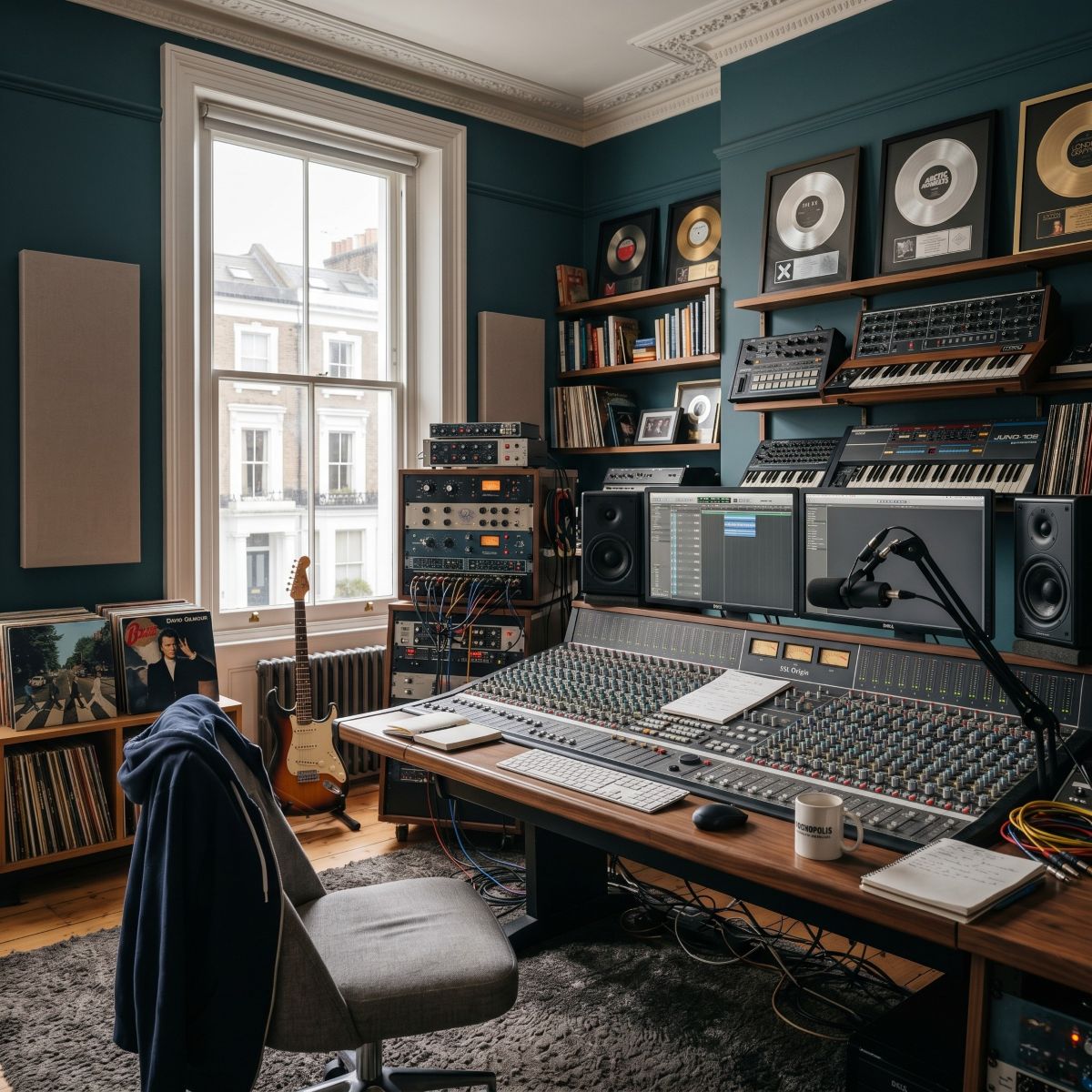
I’ve cleaned offices where I wasn’t allowed to touch the computers. I’ve cleaned kitchens where I wasn’t allowed to move the cookware. I’ve cleaned walk-in wardrobes where I was told not to breathe near the vintage leather. But nothing quite prepares you for the first time you walk into a home recording studio in Notting Hill and realise that the carpet you’ve been booked to clean is surrounded on all sides by about a quarter of a million pounds’ worth of equipment, acoustic treatment that can’t get damp, and a client who records professionally in that room the following morning.
I’ve had three of these jobs in the last couple of years, all of them in Notting Hill. The area has a particular density of them – music producers, songwriters, the occasional well-known artist who’s had a basement or rear extension converted into a proper working studio. From the street, the houses look like every other cream-stuccoed townhouse. Step into the studio room and it’s a different world entirely. A world where my usual approach to carpet cleaning becomes not just inadequate, but potentially very expensive if I get it wrong.
What Sets a Home Recording Studio Apart From Any Other Room
The first thing you notice is the sound – or rather, the absence of it. Proper studio rooms are designed to absorb and control acoustic energy, and that design is visible in every surface. The walls are lined with acoustic foam panels and bass traps. The ceiling may have cloud absorbers hanging from it. The floor is often a floating construction – a wooden platform on isolation mounts, sometimes with specialist carpet laid on top, chosen specifically for its acoustic properties rather than its appearance.
None of this is standard. None of it responds to cleaning the way a domestic carpet does. And the person who booked you almost certainly hasn’t thought about any of this when they asked for “just a carpet clean before the session tomorrow.”
In the first Notting Hill studio I cleaned, the carpet was a dense, low-pile acoustic specification laid directly over an isolation platform. Around the perimeter, the floor met the wall without a skirting board – a deliberate detail to prevent sound transmission. There were cables running under the carpet at three points, held flat by clip strips. There was a desk setup that hadn’t moved in years, and the area beneath it had collected a layer of general grime that the client had decided, somewhat optimistically, could be sorted in an afternoon.
The Moment You Realise This Isn’t a Normal Carpet Job
It tends to hit you during the site assessment. You’re crouching down to check the pile, running a quick moisture test, and you notice that the carpet is bordered on one side by a rack unit bolted to a floating floor panel. On the other side, there’s a grand piano on isolation feet. Behind you, acoustic panels come to within ten centimetres of the floor. You can’t position your extraction machine where you’d normally place it. You can’t work the carpet in the long passes you’d use in a conventional room. And if you introduce too much moisture into a floating floor construction, you risk the integrity of the acoustic isolation – which is not a conversation anyone wants to have with a working music producer.
That’s the moment you slow down, reassess, and start planning the job differently.
Working Around Equipment That Cannot Be Moved
The standard approach to a carpet clean involves moving furniture, treating the full area, and working methodically from one end of the room to the other. In a home studio, that approach goes out of the window almost immediately. The desk is staying where it is. The rack units are staying. The monitors on their stands aren’t going anywhere. In two of the three Notting Hill jobs I’ve done, there was a grand or upright piano in the room that represented, between them, the better part of a hundred thousand pounds and was not being moved by a carpet cleaner on a Thursday afternoon.
What you’re left with is a series of accessible zones and a set of constraints that dictate how you treat each one. Low-moisture methods become even more essential here – not just because of the carpet specification, but because excess water near electronic equipment is an obvious and immediate problem. You’re also working with limited access angles, which means your equipment needs to be compact and genuinely manoeuvrable rather than just theoretically portable.
Why Moving the Wrong Thing Can Cost More Than the Clean
Static electricity is a real consideration in studio environments. Professional audio equipment – particularly outboard gear, interfaces, and anything with exposed circuitry – is sensitive to electrostatic discharge. Most cleaning tools build up a static charge during use. Most of the time, that’s irrelevant. In a room full of professional audio gear, it can cause serious damage.
I carry anti-static treatment specifically for studio jobs. I’m also deliberate about which tools I use near rack units and cabling. You don’t trail a nylon brush along a skirting board that’s six inches from a patchbay. These aren’t things that come up in standard carpet cleaning training – they’re things you work out through experience and a reasonable amount of research before you take on this kind of work.
The Flooring Itself – Why It Responds Differently
Acoustic specification carpet is selected for its sound absorption and diffusion properties, not for its resilience or ease of maintenance. The fibres tend to be dense and tightly packed, which is good for controlling high-frequency reflections and not especially good for releasing embedded grit and debris. Standard extraction passes that would lift a domestic carpet pile and release trapped soil don’t produce the same result on acoustic specification material. You often need multiple passes at different angles, lower suction settings to avoid disturbing the pile geometry, and considerably more time per square metre than you’d budget for a comparable area in a conventional room.
The underlay, where present, introduces another variable. Acoustic underlay is typically denser and less permeable than domestic underlay, which changes how moisture travels through the carpet system. Over-wetting a domestic carpet is, in most cases, a recoverable problem. Over-wetting an acoustic carpet on a floating floor is a far more serious situation – water that penetrates to platform level can compromise the isolation mounts and, in worst cases, cause the platform itself to shift.
What Happens When You Get the Chemistry Wrong
The acoustic panels lining studio walls are usually constructed from open-cell foam or compressed mineral wool wrapped in fabric. They don’t seal themselves off from the room. If you use aerosol treatments or highly volatile solvents nearby, the vapour will penetrate the fabric facing and affect the foam beneath. Some cleaning product formulations cause off-gassing that the client will notice – literally – the next time they record. A faint chemical smell in a room with that level of acoustic containment doesn’t dissipate the way it would in a normally ventilated space. It sits there, and it shows up in the recording environment even if it’s not immediately obvious to the nose.
Low-VOC products only, good ventilation where the room design allows for it, and enough lead time before the next session for any residual scent to clear. That’s not negotiable on these jobs, and I make it clear before I take the booking.
Why Notting Hill Adds Its Own Layer of Complexity
The properties themselves don’t make any of this easier. Notting Hill studios are almost always conversions – Victorian terraced houses or semi-detached townhouses where a basement, rear extension, or ground-floor reception room has been adapted for recording use. The studio fit-out sits inside a period building, which means access is often awkward, ceilings can be lower than a purpose-built facility, and the doorways were designed for the nineteenth century rather than for a man carrying extraction equipment and a trolley of specialist cleaning products.
Parking is its own challenge. If you’ve ever tried to load in on a Notting Hill residential street on a weekday morning, you’ll know that the combination of residents’ bays, single yellow lines, and every other tradesperson with the same problem creates a logistical puzzle that has nothing to do with carpet cleaning but consumes a surprising amount of energy before you’ve even rung the doorbell.
The Finishing Standard When the Client Records There Tomorrow
The stakes on these jobs are higher than on most domestic cleans, and the client knows it. They’re not simply living in the space – they’re working in it, often with other professionals present, sometimes with artists whose time is being billed by the hour. The room needs to look right, smell right, and function exactly as it did before I arrived. No trace of the clean. No residual scent. No displaced cables. No marks on the acoustic panels from a tool that got too close.
I do a full walkthrough before I leave – not just a visual check, but a methodical run through everything I moved, adjusted, or worked near. Cables back in their clips. Equipment returned to any position I shifted it from. The room left exactly as I found it, minus the grime. That’s the standard on every job, but on one this technically demanding, there’s no margin whatsoever to miss it.